





























































































Denmark’s strongest Citroën Saxo
In 2013, I built VEMS engine management on Jan’s Saxo. It was done with a new wiring harness, so the entire installation was fresh and without the risk of old, corroded or poor wiring in the engine bay.
At the time, the car was running a smaller T25 turbo and produced around 235 hp, as far as I remember. Later, a larger turbo was fitted, something that looked like a GT2871, after which it came back for running-in and adjustment. Back then, the result ended at 260 hp.
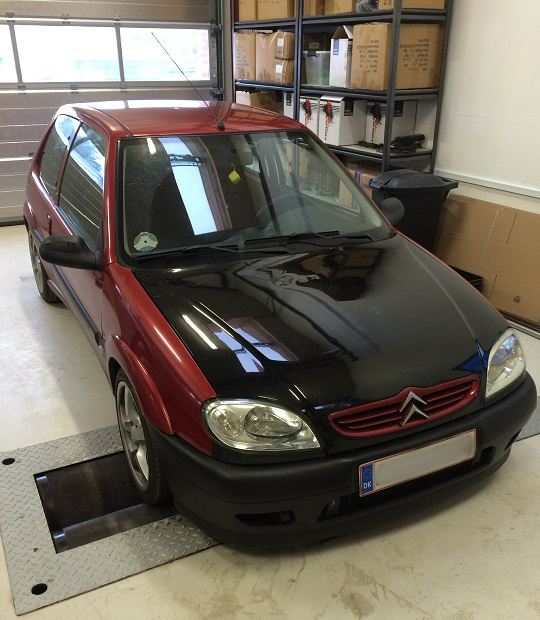
When Jan from Frydendals Auto called me at the beginning of January 2015, I must admit that I had to ask a couple of times whether it really was 2.7 bar boost pressure he said the car was running. My first thought was: "He is damn crazy." However, we agreed that he should come by so the car could be properly adjusted and tuned on the rolling road. The first Friday we had agreed on, he unfortunately had to cancel because the cylinder head had gone bad. It did not take long, however, before Jan had fitted a new cylinder head, and on Thursday, 12 February, he came by with the car.
Jan comes from Zealand, so it is of course a long trip to the other end of the country. Incredibly, Jan and his apprentice drove the whole way in the Saxo. We started with a cup of coffee and a talk about the car. Then we strapped it onto the rolling road and connected the computer to the engine management. I must admit that both then and still today, I am quite surprised that the car had even been able to run with so much boost pressure, as the engine management was not set up for it at all. I corrected the data and could then start tuning it. Quite quickly, I got the ignition and fuel dialled in properly, and with the new setup the car ran with 2.3 bar boost pressure. When we took a measurement, it delivered a full 416.6 hp and 497.4 Nm with a very nice power curve. That is cool!
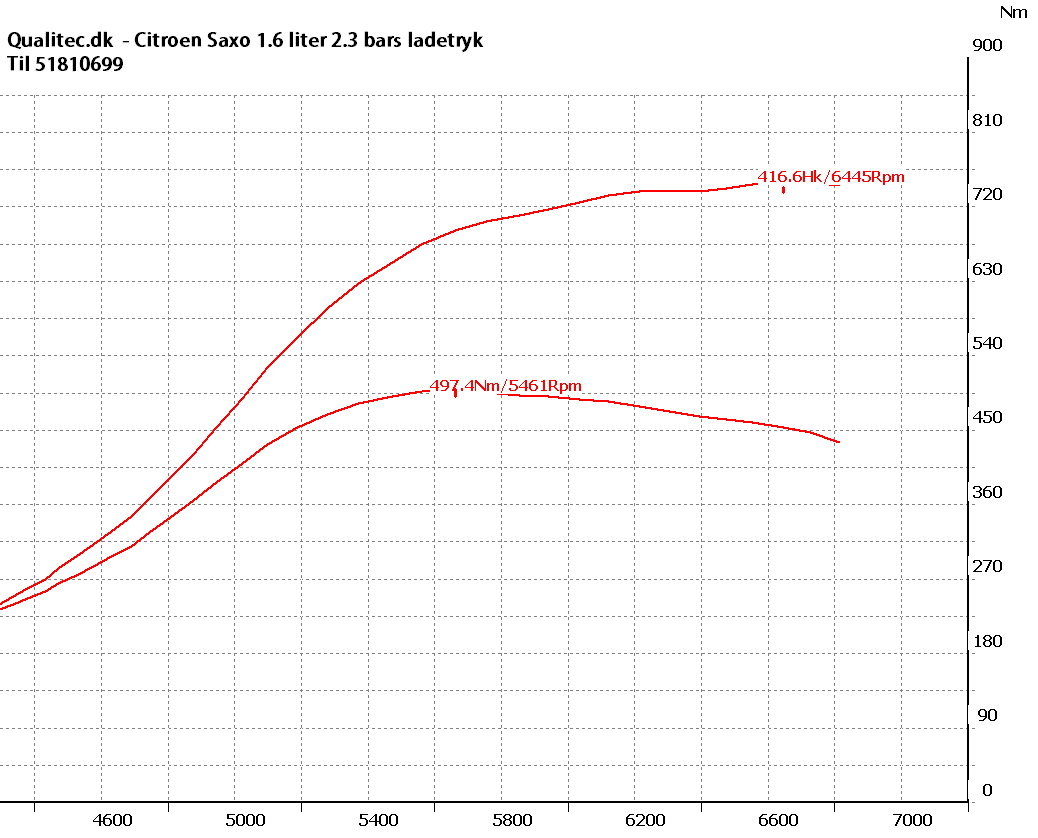
With that boost pressure, it spins the wheels all the way up in 3rd gear at around 160–170 km/h. At this point, it was fitted with a larger T4 turbo as well as a self-made turbo manifold and other components.
Jan was of course not satisfied yet and wanted to go higher in boost pressure. However, the status was that the injectors were already running at 92% duty cycle, and at the same time one driveshaft started showing signs of problems. Therefore, we had to stop for this time. That said, I still think it was a really great result.
A Turbosmart boost controller was fitted, but it was disconnected, so the gauge only showed the boost pressure. The boost pressure itself was instead controlled electronically via the VEMS engine management. The car was also equipped with methanol injection with a nozzle sized for 500 hp. The exhaust was made in 2.5" stainless steel with both centre silencer and rear silencer, as well as a VUSS valve for extra good flow. The setup also consisted of a T3/T4 turbo rated up to 480 hp, 38 mm external wastegate with open dump, 630 cc fuel injectors and a 500 hp Walbro in-tank fuel pump. The intake side was built with a homemade intake manifold and universal 70 mm throttle body. The engine was a TU4JP5 1600 cc with Wössner forged pistons and PEC H-beam connecting rods.
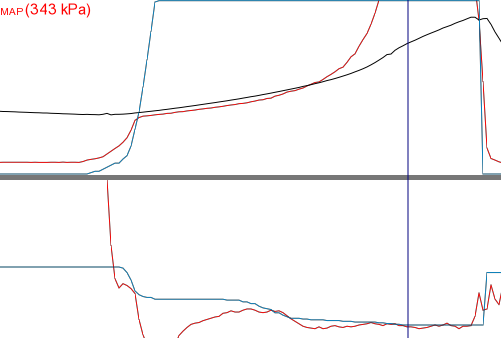
Above is a picture from Vemstune, where the boost pressure is at 2.43 bar.


