




























































































Turbocharger information
Help, I’m having problems with my turbo
Below, we have gathered questions and information about turbochargers. Read, among other things, how to install a turbo, and why it may fail.
Oil feed and return do not sit correctly on my turbo
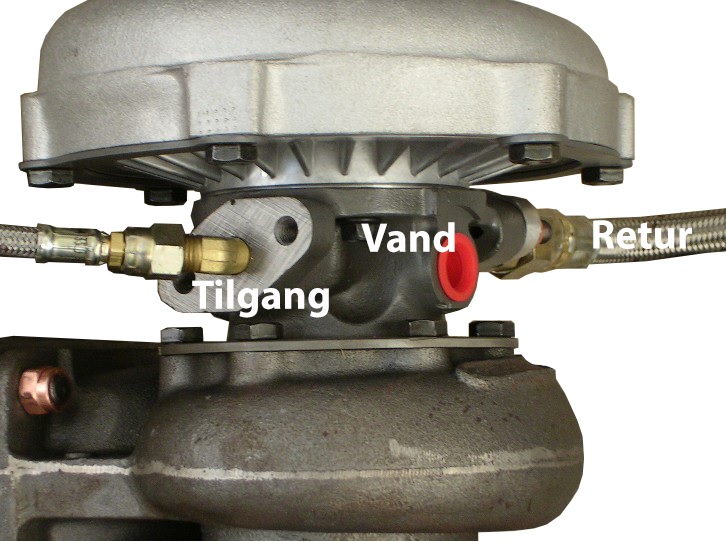
If you are installing a universal turbo and cannot get the oil feed and return to fit, you can always rotate the centre section of the turbo. You can also rotate the exhaust housing and the compressor housing. You simply need to loosen the bolts on the compressor housing and the exhaust housing. After that, you can freely rotate all three parts individually.
How do I install oil and water on my universal turbo?
When installing oil and water lines on a universal turbo, it is important that the connections are positioned correctly. The oil feed should normally be at the top of the turbo so the bearings receive proper lubrication during operation, while the oil drain should point downward and have as free and straight a fall as possible back to the engine, without sharp bends or back pressure. The water connections are used on water-cooled turbos to direct coolant through the centre housing and help keep the temperature down. Here, it is important that the coolant can circulate correctly through the turbo and that the hoses are installed so that no air pockets or unnecessary kinks occur. Incorrect installation of oil or water connections can quickly lead to poor lubrication, overheating, and damage to the turbo.
Most of our universal turbochargers have both water and oil connections and often work as follows:
The oil return is a flange with two bolt holes spaced 41 or 51 mm apart, with a centre hole for the oil return.
The oil feed is a flange with 38 mm between each bolt hole or a 12 mm banjo bolt.
Garrett turbochargers are often seen with UNF 7/16-20 threads.
Water connections are often 1/4 NPT threads.
Always remember that the feed must go vertically down into the turbo with a maximum angle of 10 degrees. The return must be at least 14 mm in internal diameter.
Defective turbo: Why has my turbo failed?
There are several possible reasons why a turbocharger fails.
The nut has fallen off on the pressure side of the turbo:
When the nut on a turbocharger falls off or comes loose, it is often due to a lack of oil pressure or insufficient lubrication. A turbo operates at very high speeds, typically over 30,000 rpm, and therefore depends on correct lubrication at all times. If lubrication fails, the shaft will very quickly overheat and can seize in the bearing. When the rotation stops abruptly under such high load, it can cause the nut to loosen.
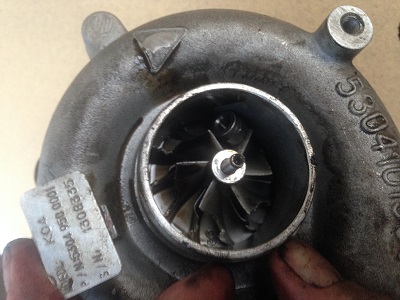
This is what a turbocharger looks like when the nut has come loose.
Lack of oil pressure:
Lack of oil pressure to the turbo can, among other things, be caused by the oil line being partially or completely blocked, or by dirt and particles having entered the turbo’s oil feed. If that has happened, it is very important to ensure that the engine is thoroughly cleaned out before installing a new turbocharger. If dirt remains in the system, the new turbo risks being damaged again very quickly. Engine flush or engine cleaner can be used together with new engine oil to clean the system, but it is important to follow the product instructions carefully.
Shaft play:
A small amount of shaft play in a turbo can be normal, especially when the turbo has no oil pressure. The bearings depend on an oil film during operation, so a slight movement can often be felt when the turbo is removed or standing still. On the other hand, it is a warning sign if there is obvious play, if the compressor or turbine wheel can touch the housing, or if there is noticeable end float. Too much play can be a sign of worn bearings or the beginning of turbo damage and should be checked more closely before the turbo is used further.


