























































































Engine control FAQ
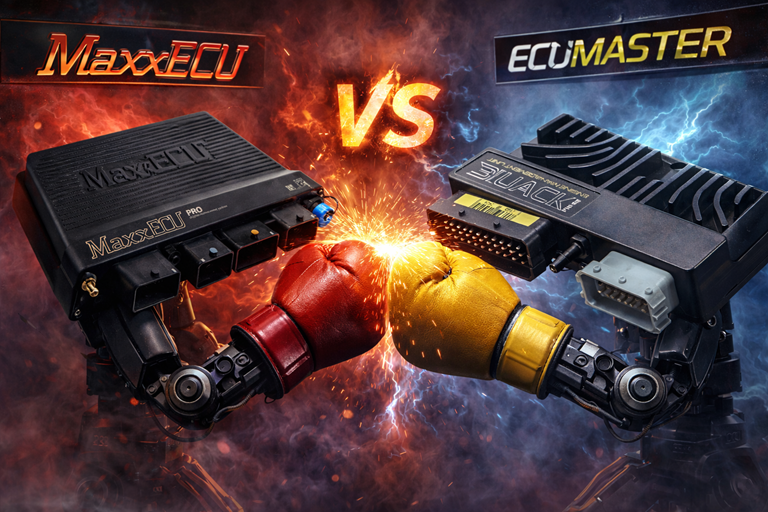
ECUMaster VS MaxxECU
What both brands can do (when choosing the correct version)
Both can deliver stable, precise engine management for the money – and it’s hard to buy “wrong.” The best ECU is often the one your tuner knows best, because it results in faster setup, fewer errors, and a better final result.
Typical features available in both camps
Engine management for NA and turbo/supercharged engines
Sequential injection and ignition
Closed loop lambda / wideband (depending on hardware)
Boost control, idle control, launch, flatshift and similar functions (level depends on setup)
Flex fuel / ethanol handling (depending on sensor/setup)
CAN communication for dashboards, expansions and sensors
Datalogging and diagnostics via software
Safety functions (lean protection, overboost, temperature cut, etc.)
Biggest difference: ECUMaster has built-in ignition drivers
ECUMaster – advantage Built-in ignition driver / igniter / IGBT.
Consequence: On many setups you can drive ignition directly without extra modules, resulting in a simpler installation.
MAXXECU – disadvantage MAXXECU generally does not have built-in drivers/igniters for “dumb coils.”
MAXXECU’s IGN outputs are logic outputs (typically +5V low-current signal), intended for coils with built-in amplifiers (smart coils) or to control external ignition modules/CDI.
If you have 2-pin “dumb coils,” you normally need an ignition driver/module between the ECU and the coils.
MAXXECU vs ECUMaster – differences
Transmission plans: 8HP now or later
MAXXECU – advantage Can control ZF 8HP transmissions if you choose that route later.
ECUMaster – alternative 8HP via a separate standalone transmission controller over CAN, e.g. Turbolamik. Typically ECUMaster Black is chosen as the ECU.
Logging: how detailed you can see what’s happening
MAXXECU – advantage High logging resolution / high log rate (very detailed data).
Consequence: Easier to catch small misfires, boost oscillations and transient issues.
Buying and completeness: how fast you can get started
MAXXECU – advantage Easy to buy as a complete package with ECU, harness, accessories and LSU.
Consequence: Less time sourcing parts and fewer compatibility surprises.
ECUMaster You can also build a very complete setup yourself, or contact us if you want help with this.
E-gas, dash and CANbus
If you want E-gas (DBW), dash and CANbus, it is typically recommended to buy ECUMaster Black, as that solution fits most projects with these functions built in.
Quick conclusion
Choose ECUMaster (typically Black) if you want built-in ignition drivers and a strong base for E-gas, dash and CANbus, plus the option for 8HP via a separate standalone transmission controller over CAN, e.g. Turbolamik.
Choose MAXXECU if you want 8HP control directly in the ECU, very high logging resolution, and a solution that is easy to buy as a complete package with ECU, harness, accessories and LSU.
What should I remember to buy for my ECU?
Connectors and Wiring
Wiring harness (plug-and-play, universal or custom)
Heat shrink tubing
Cable protection
Fabric tape
Snakeskin / cable sleeve
Relays or relay box
Connectors for:
Injectors
Coolant temperature
Air temperature
Crank sensor
TPS sensor
Lambda sensor
Ignition coils
Idle valve
Extra connectors for harness assembly
Boost valve connectors
Sensors
Wideband lambda sensor (controller + LSU if not built into ECU)
Intake air temperature sensor (IAT)
Coolant temperature sensor (CLT)
Crank sensor
Camshaft sensor
Oil pressure and oil temperature sensor (recommended combo sensor 10 bar / 140 °C)
Optional EGT sensors (exhaust gas temperature)
Ignition
Ignition coils (smart coils or dumb coils)
Ignition module / driver (if using dumb coils)
Miscellaneous
Fuel injectors (with correct flow and deadtime data)
Fuel pump and relay/control
Boost valve / boost solenoid (if turbo)
Lambda sensor bung
E-gas / throttle (if relevant)
Electronic throttle body (DBW)
Pedal sensor
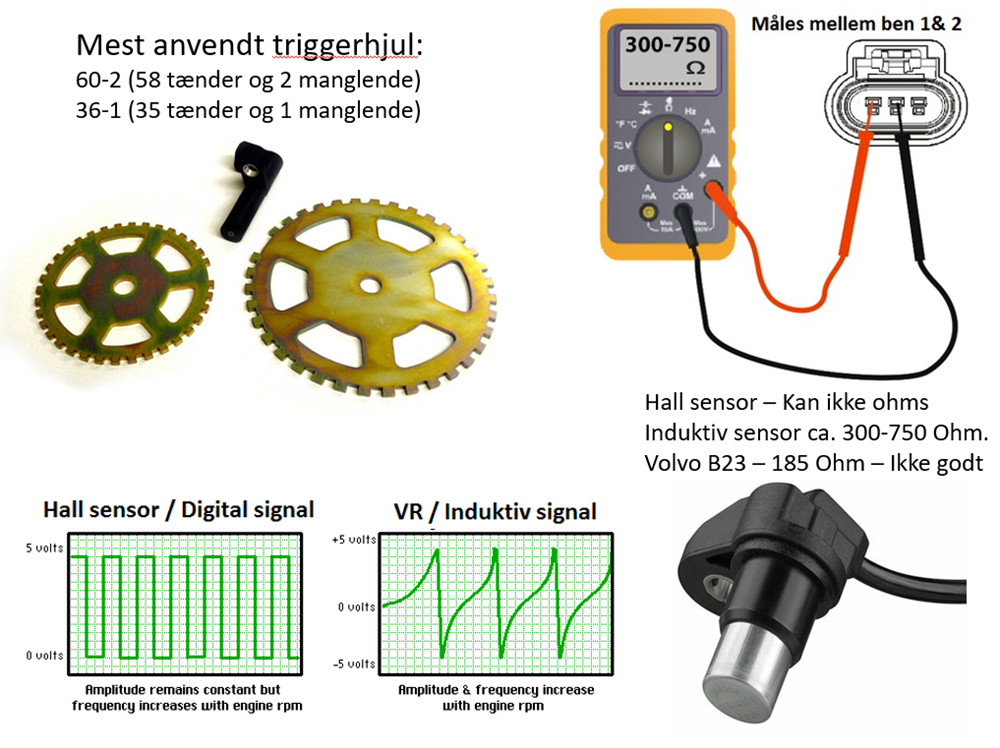
Do I have a Hall (digital) or VR (inductive) sensor